Project management is entering a new phase. Complexity is no longer the exception, but the norm: growing interdependencies, AI, regulatory requirements, resource pressure, and accelerated decision-making are profoundly reshaping the project environment.
In this context, organizations can no longer focus solely on managing timelines, costs, and deliverables. They must also address invisible costs: fragmented data, delayed trade-offs, lack of visibility, and insufficient governance. This is where Project Portfolio Management delivers its full value, by connecting strategy, priorities, resources, and execution, while the PMO is increasingly establishing itself as a strategic driver of value creation.
This shift is also transforming project leadership. Certifications remain valuable, provided they evolve alongside the profession, but they cannot replace judgment, influence, or adaptability. This is precisely what PM Conference 2026 highlights: the future of project management will depend as much on mastery of tools as on clarity, resilience, and the ability to make decisions amid uncertainty.
Elena Martineau, PMP |
|
|---|
Project Portfolio Management in Practice: Turning Strategy into Action with Clarity |
|
|
Author : IT design team
In a business environment shaped by constant change, increasing complexity, and new technologies such as AI, organizations need more than a long list of projects. They need clarity on where to invest, what to prioritize, and how to turn strategic ambitions into measurable outcomes. Strategic Project Portfolio Management (PPM) provides the framework to make these decisions with confidence.
At itdesign, we combine our expertise in PPM, governance, and strategic management with Clarity, a leading enterprise solution for project portfolio management. Our approach is built around transparency, collaboration, and sustainable value, helping organizations make better decisions and focus their resources where they matter most.
Many organizations face the same challenge: teams are working at full capacity, yet their most strategically important initiatives are not progressing as expected. Calendars are filled with meetings, teams are balancing multiple projects, and decisions are often based on fragmented information.
| |
|
|---|
Are Project Management Certifications Still Relevant? |
|
|
Author : Zara Groh
AI can build a project plan in seconds. Software can track risks, generate reports, and summarise meetings. Agile teams work differently from traditional project environments. So what exactly is a project management certification supposed to prove today? It is a fair question.
For years, certifications have provided professionals with a structured way to demonstrate knowledge, understand processes, develop a common professional language, and signal their commitment to project management. But are these skills enough? Or are other skills required today that extend well beyond knowing how to manage scope, schedules, and resources?
Projects are increasingly judged by the value, outcomes, and impact they create, not simply by whether they were delivered according to plan. Project professionals are expected to navigate uncertainty, engage stakeholders, understand the wider business context, and adapt their approach to different environments. And now, there is AI.
| |
|
|---|
Where the Money Really Goes: The Five Silent Cost Drivers in Project Portfolio Management |
|
|
Author : Mike Portworsnick Three questions. If you can answer all three in under a minute, skip my session.
• How much did your portfolio spend last year on projects that were never going to deliver their benefit case?
• How many working days did your PMO spend last quarter assembling numbers instead of acting on them?
• If your steering committee had known in month three what it knew in month twelve, which project would it have stopped?
On 29 October I will show you how much those answers really cost. Most of us cannot answer those three questions quickly. That is not a failure of professionalism. It is the predictable result of running a portfolio on numbers that are assembled by hand, arrive late, and are never quite owned by anyone.
Two cost drivers you already know. Three you do not.
| |
|
|---|
PM Conference 2026: Featuring Olympic champion Dominique Gisin │Limited seats remaining |
|
|
Author : Alpha Ziman,PMP,PMI-PBA,CAPM
Dear Members,
Project management used to be judged by a simple test: on time, on budget, to specification. That test still matters, but it no longer tells the whole story. Today's projects run on data and AI, carry sustainability targets, and often become critical infrastructure the moment they go live. Leading them takes more than a good schedule. It takes judgement, resilience and the ability to decide under uncertainty.
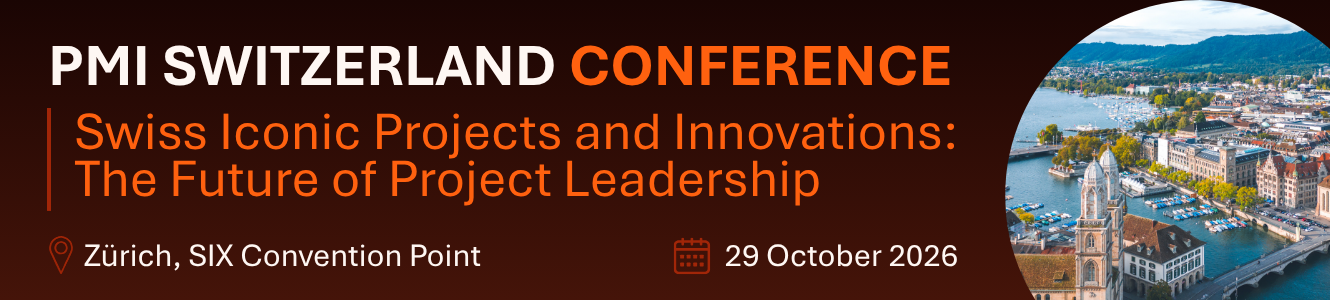
That is the focus of this year's PMI Switzerland conference, Swiss Iconic Projects & Innovations: The Future of Project Leadership, taking place in Zurich on 29 October 2026.
Why this conference, why now
Projects are changing, and so is the role of the people who lead them. Today's projects are shaped by technology, sustainability goals and public expectations, and many outlive the teams that built them. As AI takes on more routine tasks, project leaders increasingly add value through sound judgement, decision-making under uncertainty and the ability to lead people across generations and disciplines.
This conference is built around that shift. You will hear from people behind some of the most demanding projects in Switzerland and beyond, exchange ideas with peers across industries, and take home fresh perspectives for your own work.
| |
|
|---|
When Complexity Becomes the Norm: Navigating Today’s Project Environment |
|
|
Author : Shahidah A. Foster, PMP
Every other month, the Curator’s Pick brings you selected learning content from the PMI library. Each article spotlights one key topic drawn from PMI focus areas, PMI Switzerland Members’ Choice, or emerging trends.
While AI is a great tool for managing complexity, it’s simultaneously one of the many drivers of project complexity. Combine this with factors like working with interconnected stakeholders, collaborating with distributed teams, or even regulatory uncertainty, and you find yourself in a place where complexity in projects is no longer the exception. It’s become the rule.
This begs the question: if complexity is becoming the norm when it comes to project environments, what do project professionals need to do differently to navigate it successfully? With complexity being one of the many threats to project success (with reportedly almost a third of complex projects reaching failure), it’s important to recognize the signs of complexity early.
| |
|
|---|
GET TO KNOW OUR SPONSORS
|
|
|---|
Author : Alp Camci, PgMP, PMP
A warm welcome to all new members that joined our Chapter. Congratulations also to the members who obtained certifications.
The following members provided information about themselves: Iulian Virlan, Miguel Bodin, Agustín Ivan, Sara Donciglio, Frank van Lingen |
|
|---|
| The next Newsletter will be published on Monday 2nd of November.
| Would you want your article as a part of it? Please share it with us until the October 23rd through our Google Form [Click here]. |
|
|---|
Contributors: ITdesign Zara Groh Mike Portworsnick Alpha Ziman, PMP, PMI-PBA,CAPM Shahidah A. Foster, PMP |
| Copy Editor: Elena Martineau, PMP
Technical Editor:
Elena Martineau, PMP
Publications Director:
Daniel Rodellar, PMP |
|
|---|
| The PMI Switzerland Chapter is a non-profit professional business organization, and is a chartered chapter of the Project Management Institute (PMI), Newtown Square, PA, USA. Views and opinions expressed in the newsletter are those of the authors and, unless otherwise stated, do not necessarily reflect the official policy or position of the chapter or PMI or imply partnership. © Copyright 2026 Project Management Institute Switzerland Chapter. All rights reserved. Unsubscribe from our Newsletter |
|
|---|
|
|